

To find out why your waste may have been missed or rejected, click one of the following waste streams to learn more:
Common Reasons for Green Cart Rejection
NOTE: There are two separate trucks for organics and recycling. If you believe your waste has been missed or rejected, there's a chance that the truck has not come yet.
Not set out on time / Wrong collection day
Our collection workers begin their routes at 7 am. Have your waste at the curb by this time to avoid missing your collection. To double-check which day your waste is collected, click here.
Non-compostable material in cart
NO PLASTIC is permitted in the green cart, even plastic compost bags labelled "biodegradable". No glass, metal, hazardous waste or construction debris. If you're unsure of an item/material, go to Waste App: What Goes Where.
Crammed contents
A tightly packed bin can prevent all the contents from emptying into the truck. Avoid packing down materials and make use of things like dried leaves or crumpled paper to layer materials that are easily compacted.
Extremely heavy contents
Collection trucks may be unable to lift and dump your cart if it's too heavy. Not only will excess weight cause the hydraulic lift to malfunction, but it could also cause your cart to break.
Frozen contents
In the winter months, frozen contents may prevent the bin from emptying.
Hazard to Collection Worker
Examples include wasp nests or rats in your green cart. Residents are responsible for the safe removal by the collector, which may mean providing sufficient storage for any accumulating waste on the property between collection days, so domestic and wild animals do not become an issue.
Over the collection limit
1 full green cart can be collected per residence.
Location
Your green cart must be placed within 3 metres of the travelled portion of the public road, without interfering with pedestrian or vehicular traffic and snow removal operations.
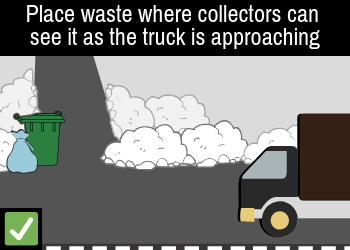
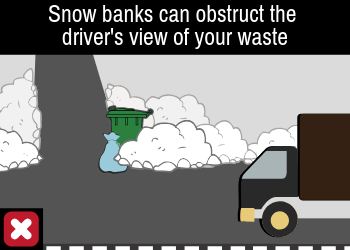
During the winter months, be sure to locate your bin where snow banks won't obstruct the view for collection workers.
Common Reasons for Recycling Rejection
NOTE: There are two separate trucks for organics and recycling. If you believe your waste has been missed or rejected, there's a chance that the truck has not come yet.
Not set out on time / Wrong collection day
Our collection workers begin their routes at 7 am. Have your waste at the curb by this time to avoid missing your collection. To double-check which day your waste is collected, click here.
Non-recyclable materials found
If you're unsure that an item is accepted for recycling, go to Waste App: What Goes Where?
Paper not separated from other recyclables
In West Hants Regional Municipality, it is required that paper recycling products are kept separate from other recyclable materials. This prevents valuable paper products from being contaminated by things like dirty food containers.
Improperly bundled cardboard
When bundling things like corrugated cardboard, pieces must be flattened and securely tied with twine, rope or tape in convenient bundles. The weight should not exceed 22 kilograms, and the size should not exceed 2ft x 2ft.
Torn bag
You are responsible for the removal of any non-collectible waste that has been scattered due to torn bags, no later than midnight on the collection day. To prevent tearing or spilling, do not overfill the bag, and please ensure it is securely tied before being placed curbside. Bags should have a minimum thickness of 0.375 mm and should weigh no more than 22 kg when filled.
Risk of bag tearing - Frozen/Too Heavy
If your bag is frozen to the ground or too heavy, it may not be collected due to the likelihood of the bag tearing apart and scattering litter on the ground.
Hazard to Collection Worker
Examples include pest interference (wasp nests, rats, etc.) or sharp items preventing the collector from safely gathering waste. Residents are responsible for the safe removal by the collector, which may mean providing adequate storage for any accumulating waste on the property in between collections so domestic and wild animals do not become an issue. You are also responsible for containing and labelling hazardous items such as broken glass.
Location
Your recyclables must be placed within 3 metres of the travelled portion of the public road, without interfering with pedestrian or vehicular traffic and snow removal operations.
During the winter months, be sure to locate your bin where snow banks won't obstruct the view for collection workers.
Common Reasons for Garbage Rejection
Not set out on time / Wrong collection day
Our collection workers begin their routes at 7 am. Have your waste at the curb by this time to avoid missing your collection. You may want to double-check which day your waste is collected.
Over the collection limit
Every collection, each residence has a limit of 5 garbage bags and 1 bulky item. A "bulky item" is a large (non-metal) item that is too large to fit into a garbage bag, such as a sofa, mattress, roll of carpet, bundle of lumber, etc. If you are placing a bulky item for disposal, it cannot exceed 75 kg (165 lbs) in weight or 4ft x 6ft in length.
Use of black bags
Garbage must be placed for collection in a securely tied, clear plastic garbage bag. See below for details on allowable "privacy bags."
More than 1 "privacy bag" in each garbage bag
For things like bathroom waste, one small solid coloured bag (e.g. a standard grocery bag; no larger than 55.88 cm x 60.96 cm when empty) may be placed in each clear bag.
Torn bag
You are responsible for the removal of any non-collectible waste that has been scattered due to torn bags, no later than midnight on the collection day. To prevent tearing or spilling, do not overfill the bag, and please ensure it is securely tied before being placed curbside. Bags should have a minimum thickness of 0.375 mm and should weigh no more than 22 kg when filled.
Risk of bag tearing - Frozen/Too Heavy
If your bag is frozen to the ground or too heavy, it may not be collected due to the likelihood of the bag tearing apart and scattering litter on the ground.
Improperly Sorted/ Contains banned items
Your garbage will not be collected if it contains items that aren't permitted for garbage collection. This includes: hazardous or highly combustible waste, hospital and pharmaceutical waste, asbestos, septic waste, hot ashes, carcasses or parts of animals that died of a communicable or reportable disease, industrial waste (including non-residential farm, forestry or fishing waste), tires designed for on-road use (24.5 inches or less in size), electronic waste, and liquids. If you're unsure of an item/material, go to Waste App: What Goes Where?
Hazard to the collection worker
Examples include pest interference (wasp nests, rats, etc.) or sharp items preventing the collector from safely gathering waste. Residents are responsible for the safe removal by the collector, which may mean providing adequate storage for any accumulating waste on the property so domestic and wild animals do not become an issue, and containing things like broken glass.
Location
Your garbage must be placed within 3 metres of the travelled portion of the public road, without interfering with pedestrian or vehicular traffic and snow removal operations.
During the winter months, be sure to locate your bin where snow banks won't obstruct the view for collection workers.
Common Reasons for Bulky Item Rejection
A “bulky item” means a non-metal item or bundle of residential waste too large to fit in a garbage bag.
More than 1 bulky item
Bulky items are limited to 1 per garbage collection. This replaces 1 garbage bag.
Item exceeds weight and size limit
Any one item cannot weigh more than 75 kg (165 lbs), and cannot measure greater than 4ft x 6ft in length.
Items not bundled
Please ensure you bundle items that may be difficult for the workers to collect, such as lumber, vinyl siding, carpet, drywall, etc.
Belongs in Metal Collection
If an item is 70% metal or more, it must be disposed of during our metal collection week in the spring.
Location
Solid waste must be placed within 3 metres of the travelled portion of the public road, without interfering with pedestrian or vehicular traffic and snow removal operations.
During the winter months, be sure to locate your bin where snow banks won't obstruct the view for collection workers.
Common Reasons for Metal Rejection
Not a metal collection week
There is 1 metal collection per year in the late spring. Once a date is confirmed, it will be added to your collection calendar. To find out, go to Waste App.
Item exceeds weight and size limit
Any one item cannot weigh more than 70 kg (154 lbs), and cannot exceed 1.22 m (4 feet).
Small items not contained
Contain small items (e.g. hardware, nails, nuts, bolts, etc.) in a bucket or container.
Non-metal items
Items must be at least 70% metal. If an item does not qualify for metal collection, set out for bulky item collection during garbage week.
Items not permitted
NO large springs, electronics, small appliances, pots/pans, or propane tanks.
Location
Solid waste must be placed within 3 metres of the travelled portion of the public road, without interfering with pedestrian or vehicular traffic and snow removal operations.
During the winter months, be sure to locate your bin where snow banks won't obstruct the view for collection workers.
